
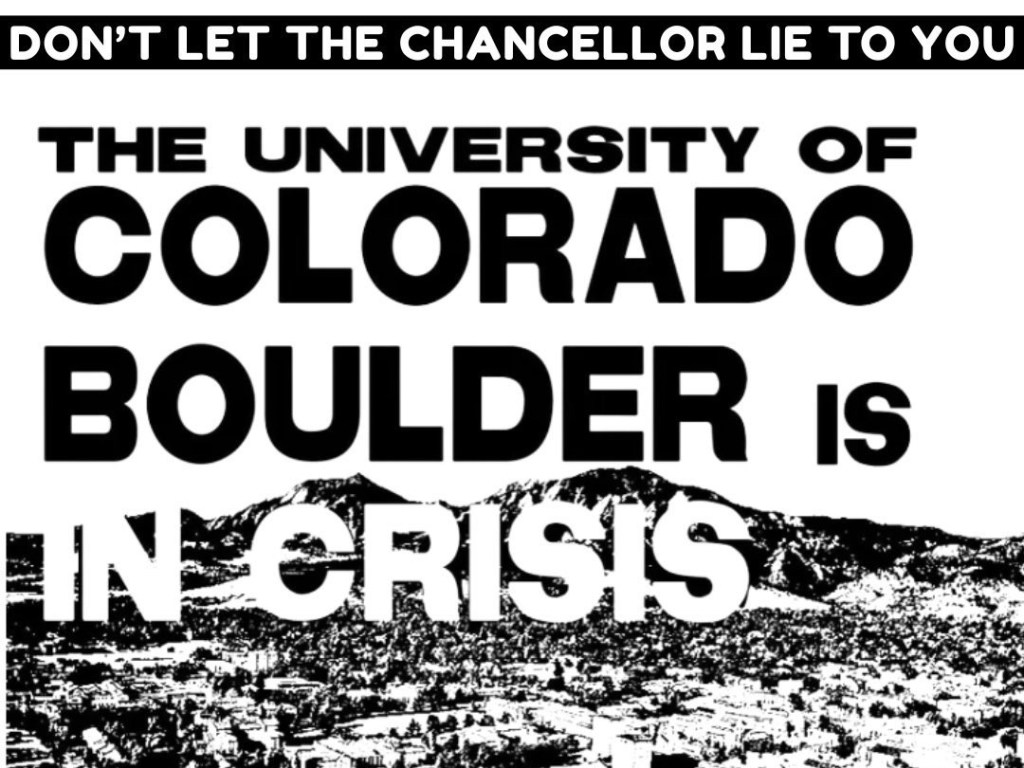

In an event hosted by Boulder Students for Democratic Society (SDS) and co-sponsored by United Mexican American Students (UMAS) y Mecha, Boulder Students for Justice in Palestine (SJP), the Feminist Underground and Queers Against Capitalism (QuAC), students rallied and held their own “Students’ State of the Campus Address” in response to Chancellor Justin Schwartz’s State of the Campus Address on April 16, 2025. This address, which was held in the Dalton Trumbo Fountain Court at the University of Colorado (CU) Boulder, also featured statements from other student groups such as Association for Students With Disabilities (ASWD), United Campus Workers Colorado (UCW), Muslim Student Association (MSA) and Climatique. A representative from Boulder SDS said in a press release before the event that, “Chancellor [Schwartz] will tell the university that things are fine. But CU is not fine. It is actively punishing dissent and cooperating with policies that put students in danger.”
As students gathered to listen to the addresses given by representatives of the groups, people who had just witnessed Chancellor Schwartz’s address started to emerge from inside the UMC, eager to listen to the students’ side of the story. Police and Student Engagement Response Team members looked on in case the students extended past the free speech hour per Campus Use of University Facilities Procedures.
Starting off the speeches for the day was a representative from SJP speaking on CU’s complicity in the Gaza holocaust through connections with weapons contractors such as Lockheed Martin and the Department of Defense. The SJP member noted the military-industrial complex and how, through said weapons contractors the university benefits off of the killing of innocent Gazans. The SJP representative also noted the assault of two student protestors and the university’s unwillingness to change its stance regarding the killing of Palestinians.
Following SJP, a member of the UCW said the “defunding of many humanities departments, which has left many programs scraping together funds, professors being laid off or being demoted to part-time work, and students in these programs struggling to get the credits they need,” while “[there is] documented evidence of hostility against female professors of color, who have experienced discriminatory treatment, ostracism, and in some cases being driven out by and at this university.” Later in the speech, the member sai that “CU is run like a business, putting profit and industry connections before the well being of its staff and students. We the workers will not stay quiet as our demands are ignored,” and ending with a call to join the union and a reminder that “we are this university, not Justin Schwartz, not Todd Saliman, not the Regents, not any of them. And if we have anything to say about it, they’ll realize this sooner rather than later.”
After the address by the UCW, a representative from SDS gave an address targeting the over-policing on the CU Boulder campus. The SDS representative said that police are given “enormous sums of money and are increasingly militarized,” while pointing to “phone records, message history, location services, and all forms of surveillance technology,” that can all be accessed by groups like Immigration and Customs Enforcement (ICE), the Department of Homeland Security, and local police to help kidnap undocumented people. The SDS member said that “every single time there’s a protest on CU’s campus, the university files a police report in attempt to use institutional violence to push them into silence,” while questioning CU’s priorities in regards to high rates of sexual violence on campus.
Following SDS was a member of MSA speaking about the state of the campus. The MSA member contested Schwartz’s claim just one hour prior that CU was “unwavering in [their] commitment to academic freedom and free expression,” by stating that “12 international students have had their visas revoked with no due process, no explanation, and no public defense,” and that “advocacy is being treated like terrorism.” In reference to the rebranding of the DEI website and its consequences, the student further said that it has led to “students [getting] doxed and harassed, students [getting] threatened, students afraid to speak, to grieve, to organize and an administration that has stayed silent through it all.” The MSA member said that “[students on campus] don’t feel safe, [they] don’t feel heard, [they] don’t feel welcome, but [they] are still here.”
After MSA, a representative speaking on behalf of ASWD gave an address critiquing the university’s minimal support for disabled students under attack by the Trump administration and calling out what they described as “largely empty gestures,” such as CU Boulder’s formation of the new Center for Disability and Access, which has, according to the ASWD representative, “has been presented as a positive change for the disabled community, but really is little more than an administrative move combing two previous offices under a new name,” while also noting that it’s “difficult to work with, often denies reasonable accommodations for arcane, bureaucratic reasons, and often has wait times in the multiple weeks for appointments.” They further pointed out the many challenges disabled students on campus face such as the issue that “numerous classrooms, labs, dorms and residences are not accessible to those of us who use mobility aids.” The ASWD member noted how many professors at CU Boulder “seem to look for loopholes in accommodations, trying to stretch definitions and exact terminology of accommodation letters in order to avoid honoring accommodations.”
Climatique, a group looking for climate justice at CU Boulder gave their address following ASWD speaking about the recent assaults on CU students by a professor for protesting a Designing for Defense class as well as noting the failure of CU’s Climate Action Plan (CAP), demanding a better and more effective plan that involves the divestment from companies funding genocide in Israel and divestment from fossil fuels. The Climatique member also noted the lack of Native voices in the development of CU’s CAP, reflecting on their slight involvement of the Center for Native American and Indigenous Studies who only asked for the university’s support of the Tribal Climate Leaders Program and were argued against, with the university claiming it was out-of-scope for the CAP.
After Climatique, a member of UMAS y Mecha gave a speech which referenced UMAS’ deep history at CU Boulder as well as Los Seis de Boulder and their fight for BIPOC students to have equal treatment on campus. The UMAS y Mecha member called on students to “take inspiration from global liberation movements, because empire has lost before and it will lose again,” and calling out Chancellor Schwartz, stating “Military Industrial Complex advocate Justin Schwartz will send you bullshit emails telling you to be respectful and kind. There is nothing respectful and kind about our tax dollars, our tuition dollars being sent to fund war, to kidnap students. F— being respectful to fascists.” They went on to further ask students to “be brave as brave so many of our international students, our undocumented students, and our Palestinian siblings have been.” The UMAS y Mecha member went on to note Denver activists who have been preventing ICE raids by simply gathering when they happen. They ended their speech with a question regarding a sanctuary campus, “what the f— is your excuse? What we’re demanding isn’t radical, it’s the bare minimum. And we’re not going anywhere, we will not stop until our demands are met.”
Subsequently, a student speaking on behalf of QuAC gave a speech not only directed at CU Boulder, but the largely white queer population at CU Boulder. This speaker called for queer students to “use [their] privilege. Know how [they] are perceived relative to other people with less privilege than you, and use that to protect them and fight for all of our rights.” They went on to note how “this neo-liberal institution uses [queer students] to claim that they are a diverse and safe campus while Chancellor Schwartz refuses to even directly acknowledge this campus culture [of bigotry].” The QuAC member noted that”in this school year alone Megan Trussell, a queer and Indigenous student, was murdered; two activists from [SJP] were suspended on bullshit charges; sexual assaults happen practically every football game; international students are continuing to have their visas revoked; ICE was invited onto campus; and the list f—— goes on.”
This coalition of student groups who co-sponsored the event are calling on the CU Boulder to declare the university a Sanctuary Campus, to divest from Israel and U.S. war manufacturers and to restore and protect Diversity, Equity, and Inclusion (DEI) programs at CU Boulder. They list their core concerns as being the revocation of 22 international student visas across the CU System, the prosecution of students who disrupted a “Designing for Defense” class which is funded by the U.S. Department of Defense, the invitation of ICE to table at a campus career fair, the dissolution of CU Engage, the rebranding of DEI and partnerships with weapons contractors and institutions with connections to Israel.
The demand to declare CU Boulder a sanctuary campus follow a wave of increased deportation and nativist rhetoric from the Trump administration. Students nationwide protest for universities to declare themselves sanctuary campuses to protect undocumented and international students who are at risk of being deported to various ICE detention centers whose conditions have been described as “unsanitary, unsafe, and inhumane,” by detained Tufts University student Rümeysa Öztürk. The calls for sanctuary campuses have become even more widespread as students like Öztürk are kidnapped by ICE for speaking out against the holocaust in Gaza, with widespread cases like that of Mahmoud Khalil, and many other overlooked cases since.
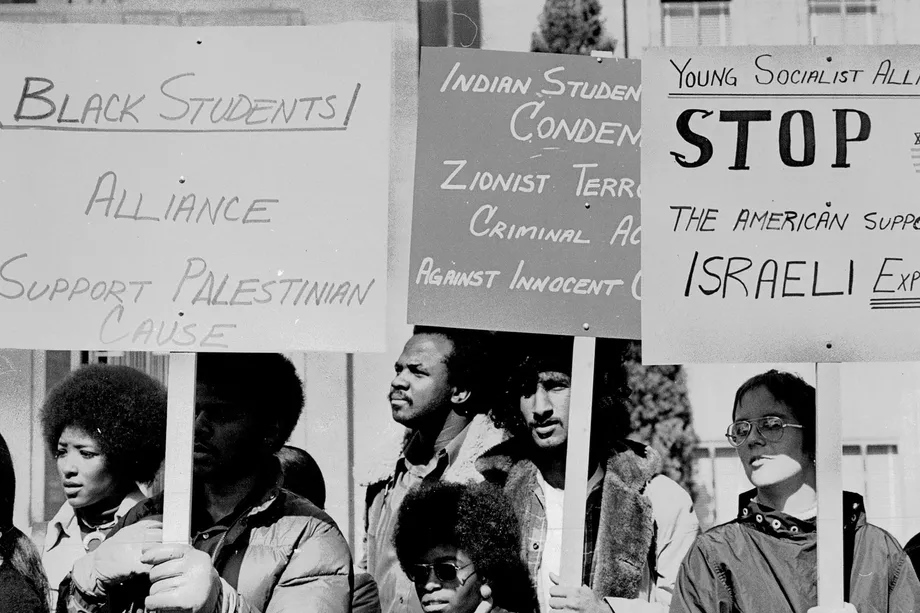
The pressure to divest from Israel as well as U.S. war manufacturers is one that has been emanating throughout the world recently since the heightened ethnic cleansing of Palestinians in Gaza by Israel following Oct.7, 2023, although divestment protests from CU Boulder students date to as far back as 1973. Universities, the U.S. military, Israel and defense contractors all benefit off of connections the university has with companies such as Lockheed Martin, Raytheon Intelligence & Space and Northrop Grumman who develop and sell weapons to the U.S. and Israel.
Restoration and protection of DEI programs refers to the dissolution of CU Engage, a community engagement center which housed programs focused on racial and environmental justice. INVST, a program that “prepares CU undergraduates to be leaders who work for social and environmental justice,” according to CU’s Community Outreach page, was ended after CU fired CU Engage staff at 8:30 a.m. on March 20 by email two days before Spring break, and broadcasted the dissolution in a campus-wide announcement that same day at 9:30 a.m. Other programs, such as CU Dialogues and UMAS y Mecha’s own Aquetza Summer Youth Program were moved to other departments without prior notifying or consulting while the Graduate Fellowship in Community-Based Research is left with the possibility of continuing “depending on availability of funding from other campus sources and continued negotiations,” according to CU Boulder. The dissolution of CU Engage follows the silent dismantling and instant modification of CU’s DEI page to the “Office of Leadership Support and Programming” on Friday, Jan. 17, just three days before the inauguration of settler president Trump.
 El Diario de la Gente
Leave a comment