
By Kiko Martinez

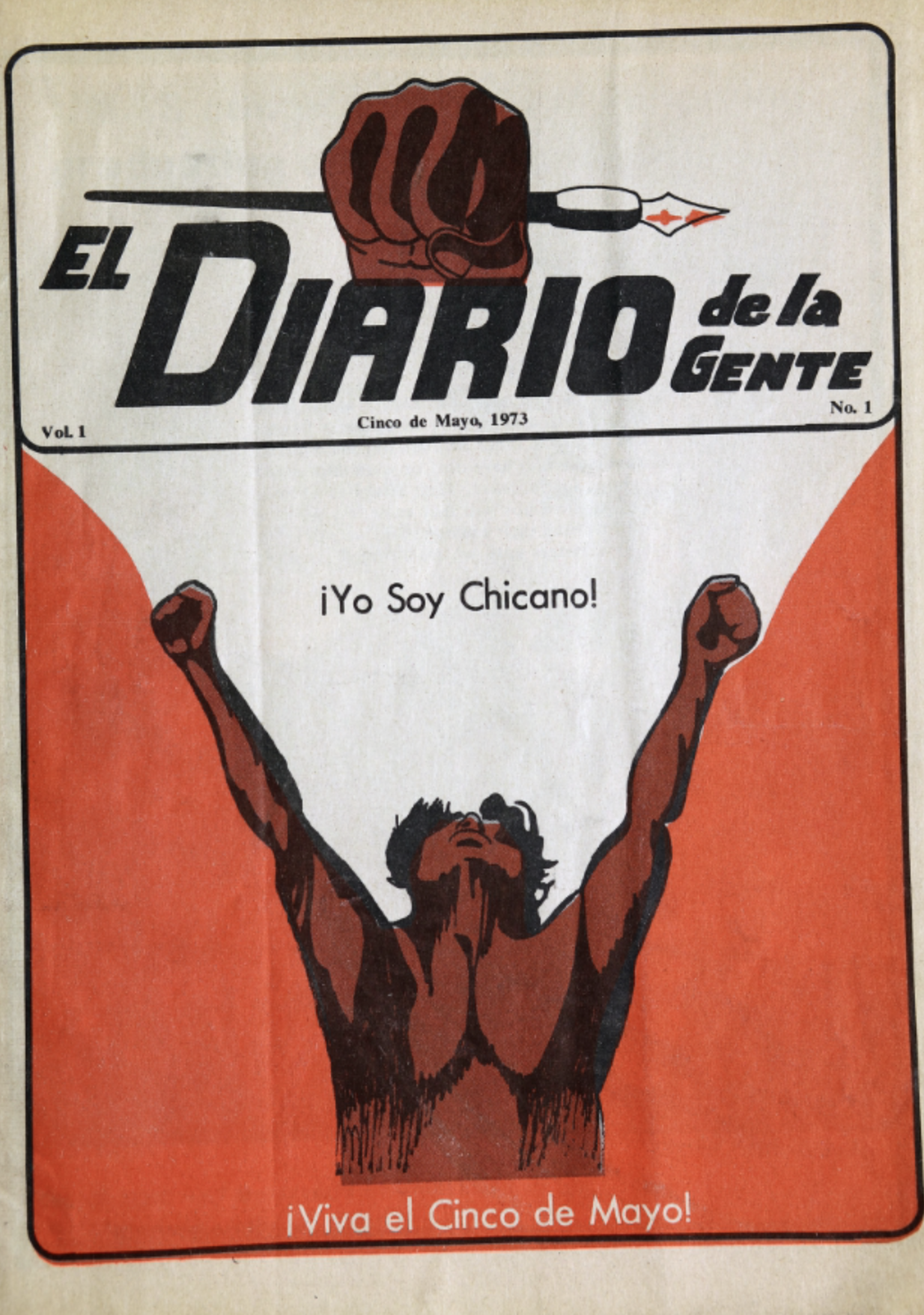
El Diario was an independent Chicanx publication founded by CU Boulder students in the summer of 1972. It published information especially important to Chicanx and other disenfranchised students. It served as an editorial, photo, and print product education tool while covering stories and presenting accurate information that no other news outlet published.
GENESIS: The spring semester of 1972 found the University of Colorado at Boulder campus locked in a no-holds-barred contest between the United Mexican American Students (UMAS) and the University administration. A few CU faculty and staff members supported UMAS while a minority faction of UMAS cuddled up to the CU administration. Florencio "Freddie" Granado was the UMAS president. Ricardo Falcón was a director of the UMAS Educational Opportunity Program (UMAS-EOP). UMAS-EOP recruited, financed and provided support services to Chicanx students at CU. Frederick P. Thieme was the CU president who led the charge against UMAS. The Vietnam War, the criminal Nixon presidency and widespread social activism were the background of the student unrest at CU.
They wanted a Chicanx Studies curriculum, a fully-funded UMAS-EOP program, parity of Chicanx students on campus that mirrored the statewide Chicanx population…
Like many "War on Poverty" and "Affirmative Action" reforms, federal, state and university officials refused to put their money where their mouths were. They never fully funded UMAS-EOP programs and the students found themselves in an ongoing struggle to finance their education. People of color faced not only economic struggles but also cultural challenges on theretofore primarily "white" university campuses. In the face of such adversity the UMAS students fought back. They wanted a Chicanx Studies curriculum, a fully-funded UMAS-EOP program, parity of Chicanx students on campus that mirrored the state wide Chicanx population, more Chicanx professors and staff, and a City of Boulder that was more friendly towards Chicanx students.

Ricardo Falcon was targeted by CU administrators as a "Jesus" figure who placed student needs ahead of the university's politics
      FBI documents released in June 2019 include a June 1972 interview with then CU President Thieme. Thieme told the FBI that "certain persons have gained control of UMAS and have utilized it as a political organization attempting to gain control of the university and operations of the federal government." Thieme went on to say, "Falcón is looked up to by the Chicanos as a 'Jesus'" who was causing trouble in schools and attempting to get students to revolt against the schools. This is the same sort of language J. Edgar Hoover used when the FBI launched a COINTELPRO operation against Martin Luther King Jr. The FBI's objective was to prevent the rise of a "Black Messiah." And this is what Thieme had in mind in the spring of 1972: Get rid of UMAS, Falcón, Granado, and other UMAS leaders. Finally, Thieme, without producing any proof, went on to tell the FBI that he believed Falcón and Granado were responsible, either directly or indirectly, for several explosions on campus. Thieme never took credit for conspiring in the campaign of police repression — beatings, tear-gassing, arrests and filing of criminal charges — against UMAS students. Thieme referred to UMAS as a "junior mafia." He told the FBI that he was convening a meeting of other presidents of colleges and universities in Colorado who were also having UMAS-type problems. In 1973 the faculty overwhelmingly voted no-confidence in Thieme.
      As the campaign for adequate student funding and meaningful change in Euro-American culture on the CU campus unfolded, the university tried to rein in the UMAS majority lead by Falcón and Granado. Motor pool privileges were restricted, job demands were increased, academic scrutiny was maximized, financial aid requirements became burdensome and police accusations and arrests of UMAS students on and off campus skyrocketed. The students mobilized and energized their group by engaging in marches numbering in the hundreds and staging protests outside and occupying spaces inside university venues such as Regent's Hall and Thieme's university residence. Falcón and Granado became Thieme's principal targets.

Several hundred UMAS students march out of UMC Fountain area to protest firing of Ricardo Falcón in spring of 1972. The students took over Regents Hall for most of the day before leaving peacefully.
      Events moved rapidly that spring and before the semester ended the university fired Falcón on trumped-up assertions that he failed to properly perform his UMAS-EOP duties. Falcón's supervisor, Patrick Vigil, was also fired when he refused to bow to Thieme's order to fire Falcón. Vigil believed Falcón was properly performing his job duties. Granado was expelled and banned from the CU campus by a student disciplinary committee based on his leadership of the students' assertiveness and protest activities.
      At the time UMAS did not have its own media outlet for news, opinions and activity. Juan Espinosa was a CU journalism student with newspaper experience. This was before the advent of the internet and social media. Print media like newspaper and magazines and electronic media like radio and television were the means of mass communication. Espinosa approached Granado with the idea of starting an UMAS newspaper. Granado instinctively understood the power of the press and told Espinosa to move forward with stories for an inaugural issue while Granado literally "passed the hat" to raise funds with which the beginning of El Diario de La Gente and for some CU journalism majors, a career as Chicanx mass communications specialists.
        INAUGURAL ISSUE: The first issue of El Diario as it became known was published October 20, 1972 and was billed as an "Election Special." Leading El Diario were Juan Espinosa and Pablo Mora. The "Election Special" covered the UMAS campaign to elect some of its members to the student government, Associated Students of the University of Colorado (ASUC). The UMAS leadership during this period stated that it had abandoned the direct-action politic of the Falcón-Granado era and would instead engage in student government to reform the University of Colorado Boulder. One of the UMAS candidates was Neva Romero. Running as part of a coalition with other progressive sectors of the CU student body several UMAS students won student senate seats. Neva Romero was victorious and became a powerful force in student government.

UMAS President Florencio Granado speaks to protesting students during occupation of Regents Hall in 1972.
      By the time the inaugural edition of El Diario was published, Falcón, Granado and their main supporters including Heriberto Terán had been kicked off the CU campus. Granado had moved to Denver where he was organizing community issues such as DiManna Recall and community-based schools for barrio youngsters. Falcón had been murdered in Oro Grande, NM, while he traveled to El Paso, Texas to participate in the First National Convention of El Partido de La Raza Unida scheduled for the Labor Day weekend of 1972. Granado was traveling with Falcón and witnessed Falcón's death. The second issue of El Diario published October 27, 1972, contained a eulogy and tribute to Falcón's leadership, sacrifices and memory. Terán's poem La Tragedia de Ricardo Falcón graced the back cover of the issue.
        MAJOR THEMES COVERED. A review of the El Diario issues available online at Colorado Historic Newspapers Collection will inform readers about the topics and themes covered by El Diario. General police violence (death, beatings, filing of criminal charges, jailing and imprisonment) against sectors of North American society is a staple today as it was yesterday. El Diario informed its readers about the police murders of Luis "Junior" Martinez on March 17, 1973, Linda Montoya (Labor Day 1973 Santa Fe police attack) and 12-year old Santos Rodriguez in Dallas, and the beatings of three Mexican farmworkers by the Hannigan Brothers in Arizona. Articles were published about war, threats of war and violence in Vietnam, Cambodia, the Americas and in Africa. El Diario reported on UMAS students' fight against hiring, training and promotion discrimination at the student recreation center and their work study assignments. The criminal prosecution of students and other activists was regularly in the news: Dennis Banks, Carter Camp, Bellecourt Brothers, Russell Means and other American Indian Movement members (1973 AIM occupation of Wounded Knee), Margie Covarrubias and Pete Escobedo (CU student government melee), Dora Esquibel (possession of explosives and weapons), Randy Esquibel and Judy Sandoval (felony political graffiti), José Gaitan and Roger Abeyta (prison murder), Inez García (woman who killed rapist's accomplice), David Gonzales, Luis Ramírez, Mario Vasquez and Ernesto Vigil (assaulting police during March 17, 1973 police raid), Juan Haro and Anthony Quintana (conspiracy to bomb Denver Police Station), Francisco "Frankie" Luevano, José Calderon, Charles Koehler, Jess Vigil (protest against Henry B. Gonzales CU appearance), Francisco "Kiko" Martínez (use of explosives), Leonard Peltier, Bob Robideau and Dino Butler (FBI deaths while attacking AIM camp), Anselmo Peralta and Ray Roybal (Ft. Lupton police station bombing), Ricardo Romero (grand jury contempt/refusing to testify), Brian Sánchez (border guard assault), and Veronica Vigil (grand jury contempt/refusing to testify).

      El Diario had stories about newsworthy issues and organizations such as the Coors Boycott; United Farm Worker (UFW) grape and lettuce boycotts; campaign for bilingual/bicultural education; border and immigration; affirmative action and the U.S. Supreme Court "Baake/Reverse Discrimination Decision"; Colorado, New Mexico and Texas land grant activity; La Raza Unida political party; election irregularities  and dirty tactics used against UMAS student government campaigns; 1977 raid and seizure by federal agents of records and documents belonging to the recently founded Producciónes Estrella Roja/La Cucaracha; environmental controversies; the struggles of minority women against racism in the women's movement; student activism on other university and college campuses in Colorado and elsewhere; CU law students accused a law professor of discrimination when he failed four minority women law students in one of his classes and, they back-downed a Colorado Supreme Court justice who said that minority lawyers were not competent and expressed a distaste for affirmative action; UMAS opposed tenure for a Chicano faculty member they accused of trying to divide Chicanx students in favor of university officials following the May 1974 explosions; as well as poetry, film and music reviews, history essays and stories about regional affairs.

      There was an editors' squabble between El Diario and a Chicano reporter for the now defunct Rocky Mountain News pertaining to the manner in which the media covered the police killing of a Chicanx. The reporter was criticized by El Diario for relying exclusively on official information for his report and failing to interview family and community members to garner their perspective of the killing and police-community relations. The Chicanx reporter should have known better, El DIario wrote. El Diario editors argued the reporters have a duty to report not only official versions of events but also to report community perspectives which is what Los Angeles Times correspondent Ruben Salazar had received acclaim at the time of his controversial death in August 1970 during the National Chicano Moratorium March Against the War in Vietnam.

For almost three weeks in May 1974, UMAS students and supporters occupied TB-1. University officials refused to negotiate until after deaths of Los Seis.
        COVERAGE OF TB-1 TAKEOVER DEATHS OF LOS SEIS de BOULDER: The June 11, 1974 issue of El Diario provided detailed coverage of events on the CU campus during the 1974 spring semester. All semester students had been trying to find a remedy to financial aid problems they were having. Many students were unable to pay for other educational expenses because their financial aid was not being released to them. Some were forced to disenroll from school. UMAS-EOP administrators were not responsive and upper echelon university officials turned a deaf ear to the students' appeals. Trapped between futile appeals to officialdom and incensed by indifference to their plight some of the students decided to once again engage in direct action.
      A group of UMAS students barricaded themselves inside Temporary Building 1 (TB-1) on May 13, 1974. The occupation of UMAS-EOP offices lasted 19 days. University officials refused to meet with the students to negotiate a resolution of the students' demands which were: Ouster of the program director and his assistant who had ceased being advocates for the students; greater student participation in UMAS-EOP decision-making process; and, increase the number of student recruits to offset the number of students who had been forced to drop out of school for lack of financial aid commitments being met by the university. José Esteban Ortega who was active in UMAS and student government affairs served as primary spokesperson for the occupying students. Only after the explosions on May 17 and May 29, 1974 did university officials agree to negotiate an end to the occupation and redress the students' complains against the UMAS-EOP program. The UMAS-EOP directors resigned; an inquiry board was appointed; program files were secured and turned over to the inquiry board; recent-graduate Juan Espinosa and Kris Gutiérrez assumed directorship of the program and the occupying students were granted unconditional amnesty for their role in the occupation. El Diario covered the explosions with reports, photos, art, editorials and letters to the editor.
      There are two competing theories for the deaths of Los Seis. The community held an intransigent and vindictive university administration and its allies responsible for their deaths. The official version contends that the occupants of the two vehicles were transporting explosives that detonated accidentally. The community was never given an opportunity to investigate the incidents. The official investigation has been criticized as deficient, alternative theories were never investigated and the physical evidence was destroyed before alternative analyses could be conducted. A federal grand jury impaneled to investigate the explosions turned into a witch hunt against the Chicanx Movement. Persons subpoenaed to testify before the grand jury's secret proceedings refused to testify. Veronica Vigil, an UMAS student, was jailed for contempt after she refused to testify. Other than punishing Vigil the federal grand jury did nothing to answer the questions and concerns the community had about the deaths of Los Seis. Nearly a half century later there are yet no answers. What has been learned is that university officials, CU and City of Boulder police departments along with the state and federal police agencies considered UMAS and many of its members to be a threat to the power exercised by the status quo. Holding this belief, they embarked on a course of repression to eliminate the challenge posed by the students to the accustomed manner of dealing with minority groups: Top down; no questions asked and punish those who resist. The ultimate wrath of those in power against those who resist is death.

Several memorial marches for Los Seis de Boulder were held during the summer of 1974. Here supporters carry symbolic coffins to a rally at Chautauqua Park bearing the names of the six who died.
CHANGING OF THE GUARD
      The original founders and producers of El Diario graduated or left school soon after the tumultuous period of 1971-1975. Many of them went on to have successful careers in mass communications as reporters, editors, columnists and photographers.
      Many collaborated in Movimeinto publications such as La Cucaracha,  Ya Basta and Tierra y Libertad.
      The students who followed continued to publish El Diario for several years. Gradually the frequency of publication declined and the last regular issue was published in 1983. The times and passions changed and this was reflected in subsequent issues of El Diario. With time the university reasserted its control over students organizations and reined in rebellious students.
      From time to time since then there have been eruptions of student unrest; some of them quite militant. But to date none of them has exhibited the energy, intensity and unremitting nature of the 1970-1975 era.
      Those times are not to be forgotten and those who sacrificed their careers, freedom and lives must be remembered. You often hear critics say if you don't like what's in the newspaper start your own — that is what El Diario did.


Leave a Reply