
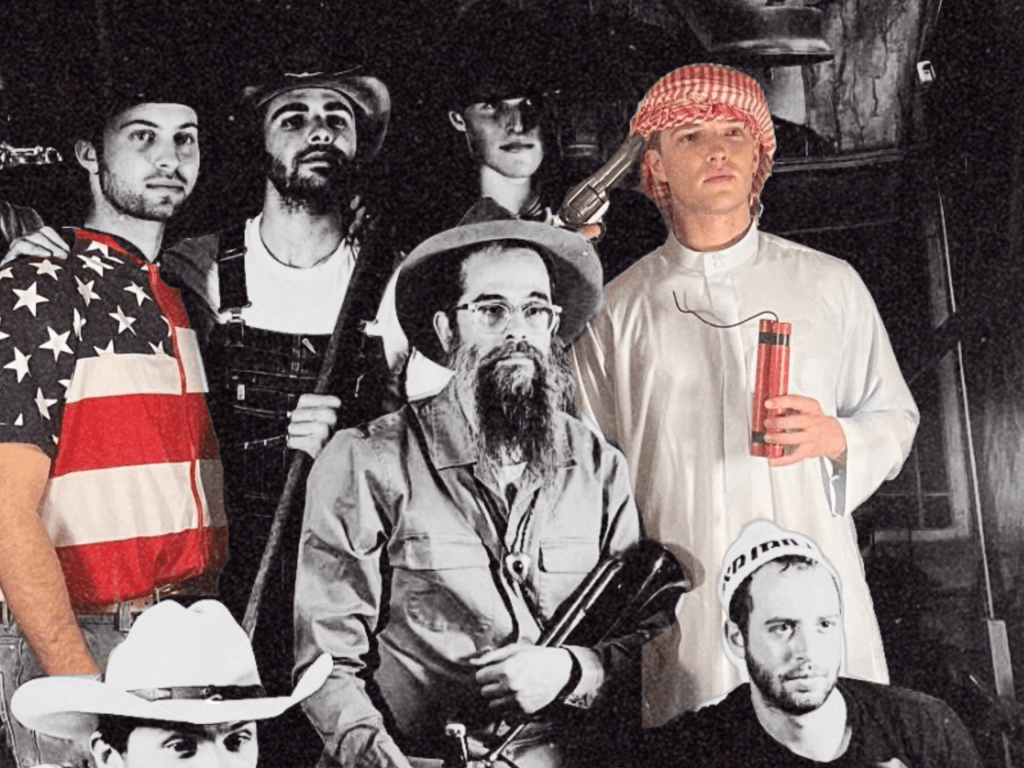
At a “Wild West” Purim party hosted by Chabad at CU Boulder on March 2, a Jewish student arrived wearing a thobe and keffiyeh, carrying a prop stick of dynamite. The costume was, by its own visual logic, an Arab terrorist, a figure so thoroughly sedimented in American popular culture that it needed only a few garments and a prop to become instantly legible. Someone photographed him at the party multiple times. Someone posted the photographs to the @jewishbuffs Instagram account. When the images attracted attention, they were deleted. As of this writing, they have been removed from their online gallery, but only weeks after they were uploaded.
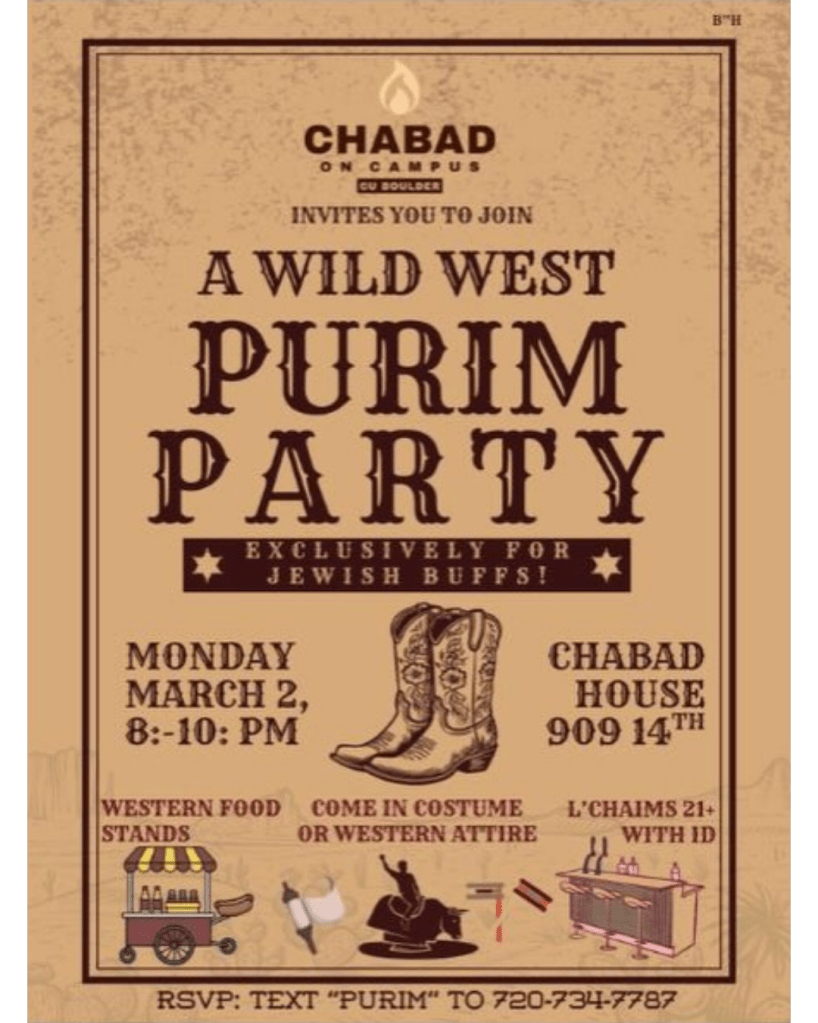
Neither the campus administration nor the organizations that hosted the event have issued any statement. Their silence is worth dwelling on as the institutional expression of a threshold below which anti-Arab representation does not yet register as requiring a response. The photographs existed in that threshold space: not quite invisible, not quite a problem, preserved on a website as if they were simply what they appeared to be, which were party photos.
It would be convenient and insufficient to read this as the story of one student making a thoughtless choice. What such a reading misses is the question of infrastructure — of what conditions made the choice thinkable, what cultural inheritance gave the costume its legibility, and what institutional context allowed it to circulate without comment. Those questions require a different kind of analysis, one that moves outward from Boulder to an occupied Palestinian city, and inward through several decades of scholarship on how colonial ideologies reproduce themselves across distance and generations. The theoretical framework here draws primarily on Edward Said’s account of Orientalism as a system of knowledge and power, Patrick Wolfe’s structural analysis of settler colonialism, and Lorenzo Veracini’s work on how settler colonial formations travel through diaspora communities.
Purim commemorates the narrative of the Book of Esther — the survival of the Jewish community of Persia, threatened with annihilation by the royal official Haman, through the courage of Queen Esther and her cousin Mordecai. It is observed with communal readings of the Megillah, charitable giving, festive meals, and costumes, and it occupies a distinctive place in the Jewish calendar as a holiday not of solemnity but of deliberate joy — a celebration, at its core, of having survived what was meant to destroy the Jewish people.1
The masquerade tradition has medieval Ashkenazi roots and was almost certainly shaped by contact with European carnival culture, as Elliott Horowitz documents in Reckless Rites (2006).2 But it also carries a theological interpretation that goes deeper than carnival. The Book of Esther is the only book in the Hebrew Bible in which the name of G-d does not appear, and this absence can be understood as a theology of concealment; the idea that the divine works precisely through hiddenness, through what is not immediately visible. The masquerade on Purim enacts that same principle: we hide ourselves to participate, however briefly, in the mode of existence of those who have always had to. In this reading, the costume acts as a form of solidarity, a practice of imaginative identification with the concealed and the endangered.3
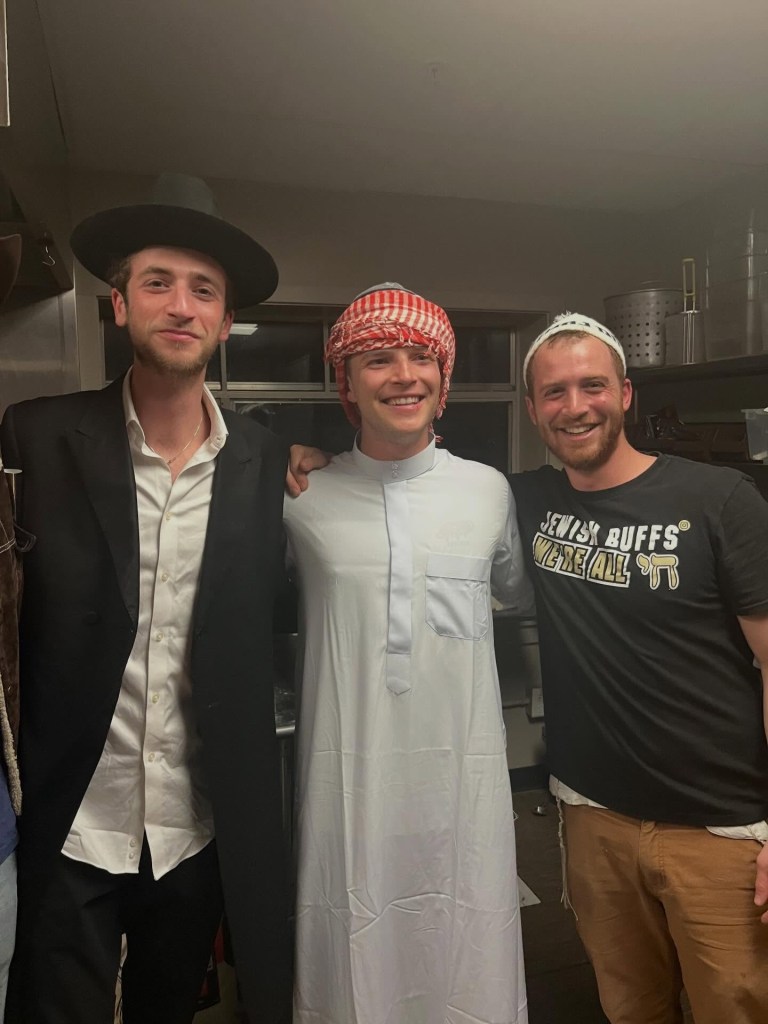
What is striking, then, about the costume at the CU Boulder party is not simply its content but the distance it travels from that tradition’s own logic. A holiday whose masquerade practice is rooted in solidarity with the hidden and the vulnerable became the occasion for costuming a member of an occupied and besieged population as a figure of menace. How that distance came to be is what this essay attempts to trace.
To understand what a “terrorist costume” means at a Jewish celebration in 2026, one has to understand the specific geography where such costumes have become a recurring feature of that celebration’s practice. That geography is al-Khalil, the city Palestinians have called by that name for centuries, and which zionist occupation authorities designate as Hebron.
The modern settlement of al-Khalil began in April 1968, when Rabbi Moshe Levinger led a group of illegal zionist settlers into the Park Hotel under the premise of a Passover seder and refused to leave afterward — a deliberate act of squatting under the guise of religious observance, which inaugurated what would become one of the most violent settler enterprises in the occupied territories.4 Levinger’s group grounded their claim on two foundations: the sanctity of the Cave of Machpelah, held sacred across faiths as the burial site of the patriarchs, and the memory of the 1929 Hebron massacre, in which 67 Jewish residents were killed in communal violence, as constituting a moral and historical demand for Jewish return. Ilan Pappé, in The Ethnic Cleansing of Palestine (2006), identifies this kind of reasoning as characteristic of zionist settlement ideology more broadly: historical Jewish presence is treated as generating a contemporaneous territorial entitlement, while the same argument — when Palestinians advance it on the basis of generations of continuous habitation — is systematically refused.5
Levinger’s refusal to leave set in motion a half-century of military-enforced expansion. The 1997 Hebron Protocol divided the city into two administrative zones: H1, under Palestinian Authority control, and H2, placed under direct administration of zionist occupation forces. Today, roughly 700 to 800 zionist settlers live in H2 alongside approximately 30,000 Palestinians who face some of the most severe movement and assembly restrictions anywhere in the occupied territories — a situation B’Tselem’s landmark 2007 report described as a “ghost town,” a once-inhabited urban center systematically drained of Palestinian civilian life to sustain a settler presence that could not otherwise endure.6
The full weight of that structure became visible on a single morning in February 1994, when Baruch Goldstein, an illegal American-Israeli settler, and follower of Meir Kahane, entered the Ibrahimi Mosque during Ramadan prayers and opened fire on Muslim worshippers, killing 29 Palestinians and wounding more than 125. The Israeli military’s response was to impose additional restrictions on Palestinian movement in the surrounding area, rather than to remove the settlers whose presence had necessitated the enforcement regime in the first place. This, as Patrick Wolfe has argued, is the characteristically inverted logic of settler colonial violence: the state’s coercive apparatus is directed toward “managing” the indigenous population, rather than protecting them, and a massacre carried out by a settler becomes the occasion for further constraint on Palestinian life rather than settler accountability.7 Goldstein is buried in Kiryat Arba, an illegal settlement adjacent to al-Khalil, where his grave has remained a site of pilgrimage for elements of the settler movement. Itamar Ben-Gvir, who kept a portrait of Goldstein in his home, now serves as Israel’s Minister of National Security.
Settlers converge on al-Khalil for Purim each year to participate in an annual parade. Hundreds of settlers — sometimes several thousand — travel from across the occupied West Bank to march through H2’s restricted streets during the holiday, moving past storefronts that have been closed to Palestinian commerce for decades, beneath the netting that Palestinian residents strung across Shuhada Street to catch rocks and other projectiles that settlers throw at them from the buildings above. Heavily armed occupation soldiers line the parade route throughout.8
Common among the documented costumes at these parades are figures in Arab dress, mock explosive vests, and caricatures of Palestinian fighters — the same representational universe the CU Boulder student entered when he put on his thobe and keffiyeh and carried his prop dynamite into a party in Colorado.9 The overlap is not coincidental, even if it is undeliberate. The image is the same because it comes from the same place: a century-long cultural construction of the Arab as inherently, visibly dangerous, a concentrated contemporary expression of which happens to be the violent settlement of al-Khalil.
The intellectual history of how this construction of Arabs was built belongs primarily to Edward Said. In Orientalism (1978), Said demonstrated that the Arab — as a figure in Western culture and scholarship — was not described so much as produced: brought into existence as a recognizable type through centuries of accumulated representation that rendered him as constitutionally irrational, ungovernable by any means short of force, and incapable of the kind of self-determination that might challenge the colonial order.10 What Said called “positional superiority”, the epistemological arrangement in which the Western observer is always already positioned as the knowing subject and the Arab as the knowable, known object, was not the product of individual prejudice but of a structural apparatus that gave such prejudice the authority of knowledge. The representations accumulated, clothed themselves in academic respectability, and eventually ceased to appear as representations at all, becoming instead something that felt like description.
In Covering Islam (1981, revised 1997), Said extended this analysis to the mass media landscape of the late twentieth century, showing how an enormously diverse population of over a billion people was progressively collapsed into a single silhouette of menace — a figure whose power derived precisely from its interchangeability, its indifference to individual specificity.11 Any Arab could become “the Arab”. Any article of Arab clothing could become a uniform of threat. Jack Shaheen’s exhaustive survey in Reel Bad Arabs (2001) catalogued over 900 Hollywood films in which this logic was given visual form, demonstrating that the keffiyeh and the thobe had been functioning as costumes of villainy in American popular culture for nearly a century before the student at CU Boulder put them on.12
Mahmood Mamdani’s contribution in Good Muslim, Bad Muslim (2004) is to show how this representational inheritance was institutionalized after September 11 into an explicit sorting mechanism — a racial epistemology in which Muslim and Arab subjects were assigned, in advance of any specific act, to the category of those whose compliance could be assumed or those whose resistance made them dangerous.13 The terrorist costume is a kind of folk expression of that sorting: it takes a body, dresses it in Arab garments, adds a prop explosive, and thereby makes the presumed equivalence of Arabness and violence visible and, implicitly, amusing. Jeff Halper, writing about the Israeli settler context specifically, argues that this construction serves an additional and more immediate function — it transforms the military infrastructure of occupation into an apparatus of self-defense, making the army’s presence in al-Khalil legible not as protection for settlers who are perpetrators of violent dispossession but as the only reasonable response to an inherently threatening population.14
The analytical move from al-Khalil to our campus is a claim that follows from Patrick Wolfe’s foundational argument that settler colonialism is “a structure, not an event” — meaning that the dispossession of indigenous peoples is not a historical episode with a beginning and an end but an ongoing condition that must be continuously reproduced, ideologically as much as militarily, as long as the society built on that dispossession continues to exist.15 Colonialism, in Wolfe’s framework, seeks to exploit and extract value from indigenous labor and land while leaving the population in place. Settler colonialism wants something different: not the native’s labor but the native’s absence, the land without the people. And because this is a structural condition rather than a completed act, the ideological apparatus that justifies the native’s removal must keep running. It cannot be switched off once the land is acquired. The representations of the indigenous as savage, as threatening, as a population whose presence is a form of aggression, are not the cause of settler colonialism but its ongoing requirement.
Lorenzo Veracini, in Settler Colonialism: A Theoretical Overview (2010), adds the dimension that connects al-Khalil to Boulder most directly: the role of diaspora communities as vectors of settler colonial ideology.16 Settler communities that maintain cultural and political ties to the site of settlement while living elsewhere — in another country, in a university town in Colorado — do not only observe the settlement project from a distance. They participate in its ideological reproduction, carrying its assumptions about land, about indigeneity, and about who constitutes a threat through the ordinary channels of communal life: through holidays and institutions, through the stories a community tells about itself and about others, through the unexamined question of whose humanity is, in those stories, treated as given and whose must be constantly re-earned.
The student who wore the costume did not need to have been to al-Khalil or to have any conscious relationship to the politics of zionist settlement. The representational logic was already fully formed in the cultural environment he inhabited, available and legible as a costume before he ever put it on. That is what it means for an ideology to be structural rather than individual: it does not require deliberate promotion to reproduce itself.
The party’s theme — “Wild Wild West” — introduces a second axis of analysis that the settler colonial framework makes difficult to dismiss as coincidence.
The American frontier mythology is, as CU Boulder professor, Patty Limerick argued in The Legacy of Conquest (1987), one of the most fully elaborated self-justifications in the history of settler colonial societies: a narrative apparatus that transformed the systematic dispossession of Indigenous peoples into an adventure story, making the violence of expropriation legible as progress and its perpetrators legible as heroes rather than as the agents of what Richard Slotkin, across his three-volume study of American mythology culminating in Gunfighter Nation (1992), identified as a culture organized around the regenerative fiction of violence; the idea that civilization renews itself by meeting and overcoming the savage other at the frontier.17,18 The “Wild West” is not a description of a place. It is a story a society tells itself about what it was doing there, and what the people already living there represented.
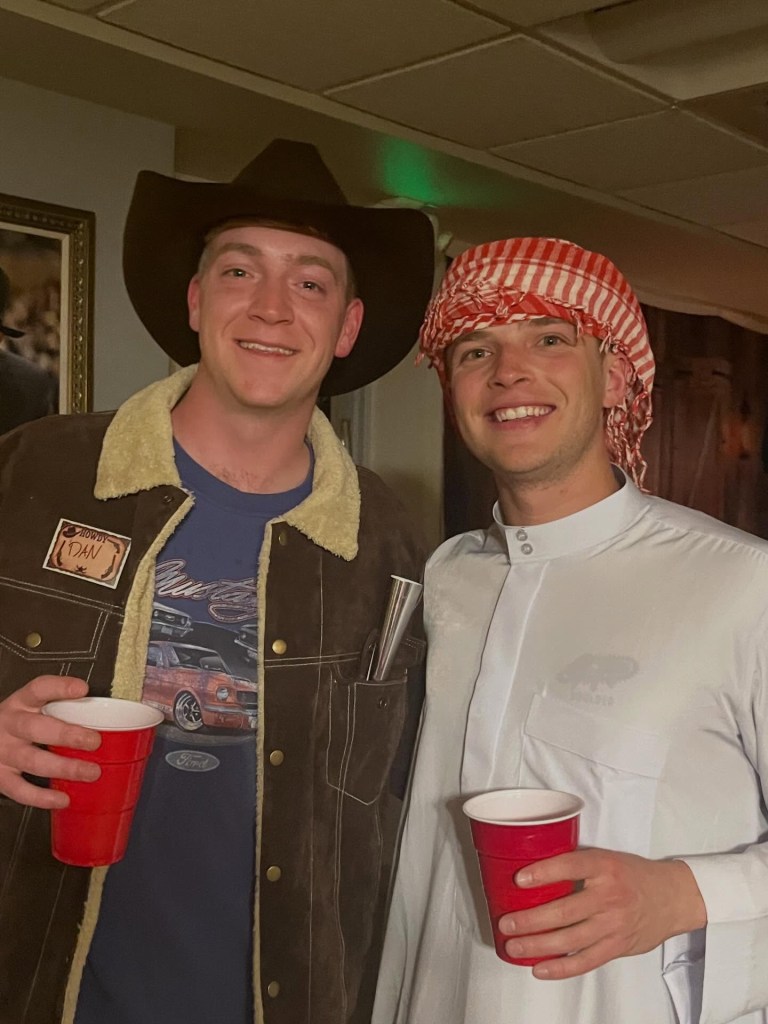
That a Jewish American organization on the unceded ancestral territory of the Arapaho, Cheyenne and Ute peoples chose this mythology as the frame for a Purim celebration, and that within that frame a student arrived costumed as an Arab terrorist, is a conjunction that seems, on reflection, less like coincidence than a manifestation of structural oppressions. The cowboy and the settler occupy equivalent positions in their respective colonial mythologies — figures of civilization whose heroism depends on the construction of the indigenous as savage, as primitive, as a threat whose removal is necessary rather than an unjustifiable and violent act. Veracini has noted the specific affinity between zionist and American frontier mythologies: both organized around the narrative of a people arriving at land that history or providence had somehow prepared for them, and both requiring, as a condition of that narrative’s coherence, the erasure of who was already living there.19
Ideological formations of the kind described here require institutions and organizations that carry certain assumptions about land and about who constitutes a threat as part of the normal texture of their communal programming. The photograph that appeared, and remained, on the CU Boulder Chabad website emerged from a Chabad-hosted event, was distributed through Chabad’s institutional platform, and sits within a specific organizational context that shapes what is and is not treated as requiring attention.
Chabad-Lubavitch, the world’s largest Jewish outreach organization, has a theological relationship to Israeli settlement that is neither incidental nor difficult to document. The messianic nationalism that became central to Chabad’s public identity under the Lubavitcher Rebbe, Menachem Mendel Schneerson, was explicitly and consistently opposed to zionist territorial compromise, on the grounds that the land of Israel was divinely promised and therefore not subject to negotiation as a political matter.20 Samuel Heilman and Menachem Friedman document in The Rebbe (2010) how this theology came to define Chabad’s posture toward questions of land and state in the decades following 1967, and Chabad houses have operated in West Bank settlements, with prominent organizational figures providing religious framing for settlement activity. None of this constitutes an indictment of every campus Chabad chapter or everyone who passes through one. It does raise a question worth sitting with: what relationship to indigenous presence, to the legitimacy of Palestinian claims, and to the Arab Other is being normalized within these institutional spaces?
There is something particular about the fact that this happened at Purim, a holiday whose own masquerade tradition carries a theology of identification with the vulnerable and the concealed. Purim asks its celebrants, through the act of costuming, to imaginatively inhabit the position of those who have had to hide in order to survive. The tradition that produced the terrorist costume is, in that sense, not merely anti-Arab; it is a distortion of Purim’s own ethical logic, one that takes the practice of imaginative solidarity and turns it into the performance of contempt.
In al-Khalil, settlers march through streets the army has emptied of Palestinian civilian life, in costumes that caricature the people whose city it is, while armed occupation soldiers ensure that the parade proceeds without interruption. In Boulder, a student arrived at a Purim party, on land the Arapaho, Cheyenne and Ute peoples were removed from by an earlier settler force, wearing the garments of a population living under military occupation, and someone took photographs that were uploaded for multiple weeks. What separates Boulder from al-Khalil is thousands of miles of geography and the comfortable distance that geography provides, but they are connected by a costume and the century of representational labor that made it legible enough to wear to a party.
NOTES & CITATIONS
- Adele Berlin, The JPS Bible Commentary: Esther (Jewish Publication Society, 2001); Michael V. Fox, Character and Ideology in the Book of Esther, 2nd ed. (Eerdmans, 2001). For the historical and liturgical context of Purim, see also Joseph Tabory, “Purim and the Influence of Persian Court Customs,” in Esther Rabbah, Jewish studies scholarship, passim.
- Elliott Horowitz, Reckless Rites: Purim and the Legacy of Jewish Violence (Princeton University Press, 2006), pp. 13–52. Horowitz provides the most exhaustive scholarly treatment of the carnival and masquerade traditions of Purim, including their relation to European festival culture.
- Isaiah Tishby, The Wisdom of the Zohar, trans. David Goldstein (Littman Library of Jewish Civilization, 1989), Vol. 3; see also Elliot Wolfson, Through a Speculum That Shines: Vision and Imagination in Medieval Jewish Mysticism (Princeton University Press, 1994), on divine hiddenness and the theology of the Esther scroll.
- Idith Zertal and Akiva Eldar, Lords of the Land: The War Over Israel’s Settlements in the Occupied Territories, 1967–2007 (Nation Books, 2007), pp. 16–31. See also Gershom Gorenberg, The Accidental Empire: Israel and the Birth of the Settlements, 1967–1977 (Times Books, 2006).
- Ilan Pappé, The Ethnic Cleansing of Palestine (Oneworld, 2006), pp. 229–255 for analysis of how historical Jewish presence is mobilized as a contemporaneous territorial claim; see also Pappé, The Biggest Prison on Earth: A History of the Occupied Territories (Oneworld, 2017).
- B’Tselem, Ghost Town: Israel’s Separation Policy and Forced Eviction of Palestinians from the Center of Hebron (May 2007), available at btselem.org; Human Rights Watch, Broken Lives: A Year of Intifada (2001), on closure and restriction in H2; on Goldstein, see Ehud Sprinzak, Brother Against Brother: Violence and Extremism in Israeli Politics from Altalena to the Rabin Assassination (Free Press, 1999), pp. 250–268.
- On Ben-Gvir and the rehabilitation of Kahanism, see Dahlia Scheindlin, “Israel’s Far Right Is Now the Center,” Foreign Affairs, January 2023; Anshel Pfeffer, “The Rise of Itamar Ben-Gvir,” Haaretz, November 2022.
- OCHA (UN Office for the Coordination of Humanitarian Affairs), West Bank Movement and Access Report, annual issues 2018–2023; Activestills Photography Collective, documentary archive of Hebron, 2005–present; B’Tselem video documentation project, Hebron, 2008–present.
- See Human Rights Watch, Separate and Unequal: Israel’s Discriminatory Treatment of Palestinians in the Occupied Palestinian Territories (2010); and journalists’ accounts of the Hebron Purim parade, including coverage in Haaretz and +972 Magazine, 2018–2023.
- Edward W. Said, Orientalism (Pantheon, 1978), esp. pp. 1–28, 201–225, and 284–328. Said’s account of “positional superiority” — the epistemological relation in which the Western observer is always already positioned as the subject knowing an Oriental object — is directly applicable to the representational logic of the terrorist costume.
- Edward W. Said, Covering Islam: How the Media and the Experts Determine How We See the Rest of the World (Pantheon, 1981; revised ed. Vintage, 1997). The revised edition includes a preface reflecting on the intensification of the Islam-as-threat construction in the decade after the first publication.
- Jack G. Shaheen, Reel Bad Arabs: How Hollywood Vilifies a People (Olive Branch Press, 2001; updated ed. 2009). See also the documentary film of the same name (dir. Jeremy Earp, 2006). Shaheen’s analysis of the sartorial dimensions of the Arab villain — the specific role of the keffiyeh and traditional dress as visual codes for threat — is particularly germane.
- Mahmood Mamdani, Good Muslim, Bad Muslim: America, the Cold War, and the Roots of Terror(Pantheon, 2004), esp. pp. 17–62. Mamdani’s argument that the “war on terror” required a racially pre-sorted Muslim/Arab subject complements Said’s genealogical account by attending to its post-9/11 political instantiation.
- Jeff Halper, War Against the People: Israel, the Palestinians and Global Pacification (Pluto Press, 2015), pp. 42–68; see also Neve Gordon, Israel’s Occupation (University of California Press, 2008), on the bureaucratic and discursive mechanisms through which Palestinian resistance is systematically recoded as terrorism.
- Patrick Wolfe, “Settler Colonialism and the Elimination of the Native,” Journal of Genocide Research8, no. 4 (2006): 387–409; and Wolfe, Settler Colonialism and the Transformation of Anthropology(Cassell, 1999). The argument that elimination is a structural logic rather than a historical event is the foundational contribution of this framework.
- Lorenzo Veracini, Settler Colonialism: A Theoretical Overview (Palgrave Macmillan, 2010), esp. pp. 16–44 on “transfer” and pp. 97–114 on the diaspora as a vector of settler colonial ideology. See also Veracini, The Settler Colonial Present (Palgrave Macmillan, 2015).
- Patricia Nelson Limerick, The Legacy of Conquest: The Unbroken Past of the American West (W.W. Norton, 1987). For the specific mechanisms by which frontier mythology organized the elimination of Indigenous peoples, see also Roxanne Dunbar-Ortiz, An Indigenous Peoples’ History of the United States (Beacon Press, 2014).
- Richard Slotkin, Gunfighter Nation: The Myth of the Frontier in Twentieth-Century America(Atheneum, 1992); see also Slotkin, Regeneration Through Violence (Wesleyan University Press, 1973) and The Fatal Environment (Atheneum, 1985) for the full trilogy.
- Veracini, Settler Colonialism: A Theoretical Overview, pp. 56–72, on the resonances between Zionist and American frontier mythologies; see also Derek Penslar, “Zionism, Colonialism and Postcolonialism,” Journal of Israeli History 20, nos. 2–3 (2001): 84–98.
- Samuel Heilman and Menachem Friedman, The Rebbe: The Life and Afterlife of Menachem Mendel Schneerson (Princeton University Press, 2010), esp. Chapter 9; Sue Fishkoff, The Rebbe’s Army: Inside the World of Chabad-Lubavitch (Schocken Books, 2003), for an account of Chabad’s global expansion and its ideological dimensions.
- Hillel International, “Standards of Partnership,” adopted 2010 (available at hillel.org); Open Hillel, Report on the Stifling of Israel/Palestine Discourse on Campus (2015); Rebecca Vilkomerson, “Hillel’s Loyalty Oath,” The Nation, October 16, 2012; Lila Corwin Berman, Speaking of Jews: Rabbis, Intellectuals, and the Creation of an American Public Identity (University of California Press, 2009), for broader context on the institutional politics of American Jewish organizations.
 El Diario de la Gente
Leave a comment