
On Feb. 28, 120 children would leave their homes, seeking education at the Shajareh Tayyebeh girls’ elementary school in Minab, Iran. They would never return home because three Tomahawk missiles would be launched at their school, killing 175 people in total. Inside these missiles were parts produced by Boulder-based Ball Aerospace, who have longstanding financial ties to the University of Colorado (CU) Boulder.
News of the U.S.-caused wars and genocides throughout West Asia has become common, but what many don’t know is the direct link between these wars and genocides and universities like CU Boulder.
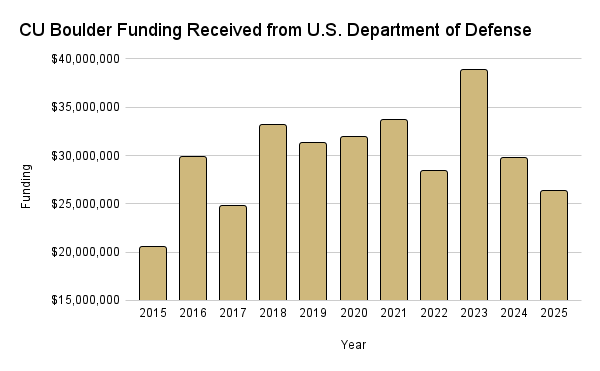
In the past 10 years, since 2015, CU Boulder has consistently received over $20 million in funding from the U.S. Department of Defense (DoD), according to CU Boulder’s yearly fiscal reports.
A lot of these funds go to new technology developed on the CU Boulder campus for use in war, according to Annabelle, an organizer with Boulder Students for Justice in Palestine (SJP). This includes CU Boulder’s Research and Engineering Center for Unmanned Vehicles, where students build AI-driven vehicles for use by the DoD.
“CU Boulder functions in a lot of ways as an extension of the United States government and the United States military,” said Annabelle. “We have projects that take our classmates, undergrads, and teach them to design tools of war.”
One of SJP’s main goals is to fight these connections. This included an engineering career fair protest, which led to SJP’s deregistration as a registered student organization
It was in 2023 when CU Boulder received the most funding from the DoD. The university received over $38 million. Annabelle believes this jump in funding was for the support of new hypersonic weapon development. The DoD would not need to start its own projects if it could fund ongoing research at CU Boulder.
Despite recent jumps in funding, DoD connections to CU Boulder are not new.
“These ties to the DoD and to the military industrial complex go back at least to the 1950s,” said CU Boulder political science professor Scott Ritner. “It doesn’t feel all that long at times: 70, 80 years of this connection. But I think that that is really a long time in terms of dependence on the money and the stability of these kinds of relationships.”
Ritner, whose research focuses on antifascism, believes a change has to happen at a larger scale than CU Boulder for DoD connections to be cut. “I think probably the biggest thing that would need to happen in order for that to change is for the United States to stop being the most militarily organized society on the planet,” said Ritner.
Despite the desire for large-scale change, SJP member Max believes local change is still possible. They joined SJP following 2023’s Al Aqsa Flood to learn more about Israel’s colonization of Palestine and how they could make a change locally.
The common perception that Boulder is progressive is not true, according to Max. They believe many politicians in Boulder hold anti-Palestinian views that go against so-called progressive values.
“Boulder is very affluent, very white, very detached from a lot of the political unrest we’re seeing domestically and internationally,” said Max, who was suspended from CU Boulder for the career fair protest. This is why they believe these military connections to CU Boulder go unnoticed.
The DoD and CU Boulder profit from their relationship, leading to war and genocide as a result. “I think it’s really about building a culture that rejects violence at its root. And uprooting it from CU Boulder,” said Annabelle.
 El Diario de la Gente
Leave a comment