
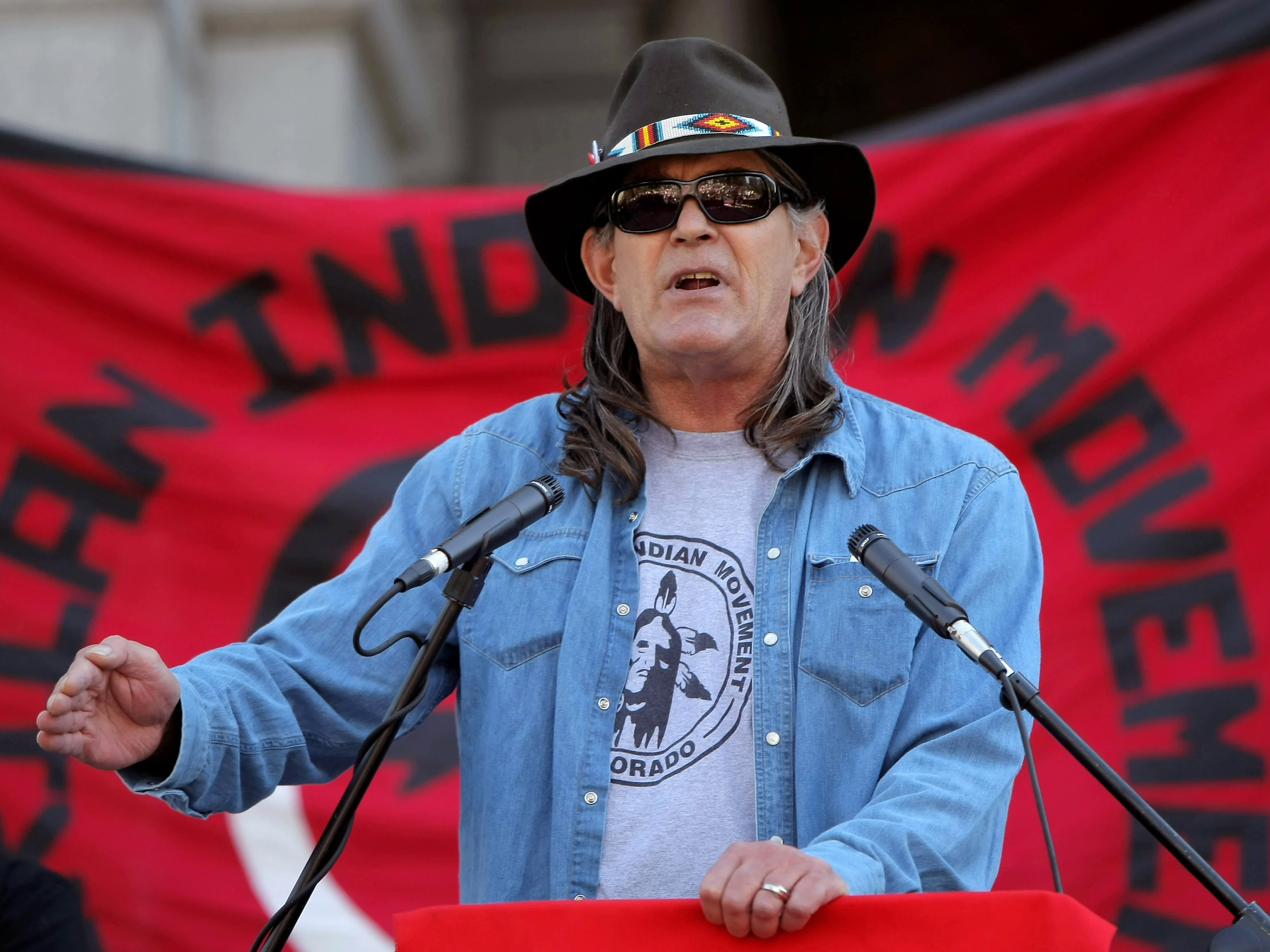
Ward LeRoy Churchill, former leader of the Colorado American Indian Movement (AIM), passed away on August 11 from a stroke. Churchill was 78 years old and was living in his Atlanta, Georgia homeland.
Most people today know Churchill as the fake Indian at the University of Colorado (CU) Boulder who said America deserved 9/11. Even if he was right, there is much more to Churchill, including the work he did with AIM, the Rainbow Coalition and the Indigenous knowledge he held.
Early Life and Identity Crisis
Churchill was born in 1947 to a Mvskoke father and Tsalagi mother, although there were rabid debates on his ancestry and identity around the time of his firing from CU Boulder. Bourgeois news sites like the Rocky Mountain News (1859-2009) and the Denver Post tore apart genealogical records and census data to disprove his identity.
Other native activists and tribal leaders like well-known comprador Suzan Harjo of the Mvskoke and Tsistsistas Nations denounced him writ large, claiming he was a “pseudo-Indian” because he was “Caucasian in appearance…wearing dark glasses and going for the look of an Indian activist circa 1970.” Other Indian scholars like Patti Jo King of the Tsalagi Nation argued that “the Indian community [would] suffer the consequences of his recklessness….”
In 1966, during the Resistance War Against America to Save Viet Nam, Churchill was drafted into the U.S. Army and later returned in 1968. After returning, he began organizing with the Chicago Students for a Democratic Society (SDS). He would use what he learned in Viet Nam to instruct members of the Weather Underground through firearms and explosives training.
“I was on the ground pulling triggers. You can’t undo that. And I have an obligation to do what I can by way of compensation”
Churchill, Ca. 2005
While organizing with SDS, he befriended one of the founders of the Peoria Black Panther Party, Mark Clark. Clark had helped establish the Free Breakfast Program, organized clothing giveaways for children and was attempting to establish a free clinic and a sickle cell foundation when he was killed during the 1969 raid on Fred Hampton’s apartment.
Introduction to AIM and Higher Education
After three Weathermen blew themselves up while building bombs in the 1970 Greenwich Village Townhouse explosion, Churchill became disillusioned with the white left and joined AIM in 1972. Churchill was a member of AIM’s security team and did work on the Pine Ridge Reservation when the Guardians of the Oglala Nation were terrorizing Lakotas.

During this time, Churchill became good friends with AIM leader Russell Means. Churchill would become Means’ aide and occasional speechwriter following the Wounded Knee Occupation.
Churchill attended Sangamon State University in Springfield, Illinois, where he earned a bachelor’s in technological communications in 1974 and a master’s in communications theory in 1975. He then worked as an instructor of studio art and art history at Black Hills State College in South Dakota for a year in 1976.
After teaching in South Dakota, Churchill moved to Colorado and was the director of the Title IV Indian Education Program for the Boulder Valley School District. Churchill was hired as the director of the American Indian Equal Opportunity Program (EOP) in 1978.
At CU Boulder, Churchill became a very important figure for the American Indian EOP. He was the primary grant writer and recruiter of Indigenous students, earning the university over $10 million between 1978 and 1986. Despite his growing position at CU Boulder, Churchill did not settle down when it came to political organizing.
In April 1983, Churchill and Russell Means’ brother, Dale Means, travelled to Libya in a delegation with the Republic of New Afrika, Nation of Islam and other Black liberation organizations. There, the pair representing AIM met with Muammar Qaddafi.
From 1986-1991, Churchill served as the director of the University Learning Center, where he helped instruct provisionally admitted students. In 1987, he helped found CU Boulder’s Center for the Study of Ethnicity and Race in America (CSERA), a precursor to the Ethnic Studies Department. Between 1988 and 1991, Churchill was hired as a tenured associate professor.

Churchill was deeply involved in Colorado AIM’s organizing efforts against the Denver Columbus Day Protests. He served as co-director until moving away from Colorado in 2012. Throughout the 1980s and 1990s, Churchill served as the national spokesperson for the Leonard Peltier Defense Committee. Peltier was convicted of killing two FBI agents in 1976 and was granted clemency in 2025.
Churchill accepted the position of distinguished visiting scholar of the humanities at Alfred University in 1991. He did not want to return to CU Boulder and was offered multiple positions in New Mexico and California, but ultimately returned to CU Boulder to continue work in the CSERA.
CU Boulder wanted Churchill back, so they offered him a position as a tenured associate professor in the Communications Department because CSERA hadn’t been made a department yet. The Sociology and Political Science Departments refused to host him, and Communications begrudgingly accepted him.
From August 12 to 22, 1993, Churchill served as a justice and rapporteur of the Peoples’ International Tribunal on the Rights of Indigenous Hawaiians. The tribunal, held on the 100th anniversary of the U.S.’s overthrow of the Kingdom of Hawai’i, found the U.S. guilty of genocide, ecocide and other international crimes.
That same year, AIM split into two camps comprised of the Vernon and Clyde Bellecourt brothers-led AIM-Grand Governing Council (GGC), and the Means/Churchill-aligned Autonomous AIM comprised of 13 independent chapters. The Bellecourts were attempting to create a national AIM with the GGC, and the 13 Autonomous AIM chapters wanted to function as their own organizations.
This split happened as a consequence of the Sandinista Revolution. AIM GGC supported the Sandinistas despite their treatment of Indigenous Miskito populations following the revolution, and Autonomous AIM supported the Miskitos. Despite Sandinistas later apologizing for poor treatment and offering an autonomous land agreement to Miskitos, friction within AIM had already grown into a split.
AIM GGC and the Bellecourts criticized Churchill following the split in AIM, calling him and other Autonomous AIM leaders “fake Indians.”
In March 1994, the Student Coalition for the Advancement of Ethnic Plurality (SCAEP) issued demands for CU Boulder to recognize CSERA as a full department with major, minor, master’s, and PhD programs. Along with United Mexican American Students (UMAS) y MEXA, SCAEP held mass student protests and issued a six-day hunger strike. This ended with the conversion of the Afro-American studies major into the Ethnic Studies Department in 1996.

Churchill was then transferred to the Ethnic Studies Department in 1996 and promoted to full professor with tenure in 1997. He would become the department chair in 2002.
Some People Push Back
One day after the September 11, 2001 attacks, Churchill wrote his infamous essay “Some People Push Back: On the Justice of Roosting Chickens.” Still, the controversy wouldn’t come for three more years when Hamilton College professor Theodore Eismeier caused an uproar over the essay. Eismeier hadn’t known about the essay before researching Churchill, but only knew he was involved in leftist spaces.
Eismeier and other reactionary professors learned Churchill was scheduled to speak at Hamilton College and sent links of Churchill’s writings to the administration, who refused to cancel the event. The professors then wrote editorials to the Hamilton College newspaper, and the story was picked up by a local newspaper. The article was posted on a conservative media website, and one week later, Fox News’ “O’Reilly Factor” ran the first of 41 segments on Churchill over the next 90 days.
From there, the story spread throughout national news, and Churchill was the subject of intense scrutiny. Colorado governor Bill Owens said he would withhold all funds to CU Boulder until Churchill was fired. Owens would later call CU President Elizabeth Hoffman and threaten to “implement Plan B” if she did not fire Churchill. Hoffman refused and resigned one month later.
Colorado senator Hank Brown was selected to replace Hoffman, and had vowed to deal with the “Churchill situation.” Brown told the Board of Regents to fire Churchill, but they did not fire him; instead, they authorized Chancellor Phillip DiStefano’s proposed investigation of Churchill’s published works. The Regents would fire Churchill on July 24, 2007, alleging academic misconduct.
Churchill filed a lawsuit against the Regents on July 25, 2007, alleging they fired him for exercising first amendment rights and not academic misconduct. In March 2009, a jury unanimously agreed with Churchill and awarded him $1 in damages. He did not want to be paid damages, but wanted to be rehired. The judge presiding over the case argued that because he was only awarded $1, there were no damages and Churchill did not have to be reinstated at CU Boulder, overturning the jury’s decision.

Later Life
The Colorado Supreme Court upheld the decision in 2012. The U.S. Supreme Court declined to hear the case, and Churchill moved to Atlanta, Georgia, with his wife, Natsu Saito, following the Supreme Court decision.
Churchill largely stepped away from academia, occasionally appearing in Pan-African and leftist media circles like University of Houston’s Dr. Gerald Horne’s “Freedom Now” radio show and the “Black Liberation Media” podcast co-founded by Morgan State University’s Dr. Jared Ball. Churchill returned to CU Boulder in 2017 as a keynote speaker for the American Association of University Professors’ Academic Freedom Symposium.

Conclusion
Churchill’s career may largely be overshadowed by his last few years at CU Boulder, but his other work should not be forgotten or overshadowed as it has been today. CU Boulder used Churchill to gain millions of dollars, and when his politics got too radical, they threw him away.
His writings have helped organizers understand the inner workings of the FBI’s COINTELPRO and U.S. counter-insurgency. He developed an understanding of Indian identity and resistance, all with his unique abrasive writing style. Churchill claimed to be neither a Marxist nor an anarchist, opting for the identity of Indigenist that he coined: one who fights for Indigenous liberation as a top priority and “who draws upon the traditions—the bodies of knowledge and corresponding codes of value—evolved over many thousands of years by native peoples the world over.”
Even if the media or broader Indian and Ethnic Studies intelligentsia do not recognize the large contributions of Churchill, his dedication to Indigenous liberation and work with AIM is irrefutable.
Rest in Power, Ward LeRoy Churchill


Leave a Reply